WHY WE USE FRAMEWORKS — AND WHAT WE SHARE (AND DON'T)
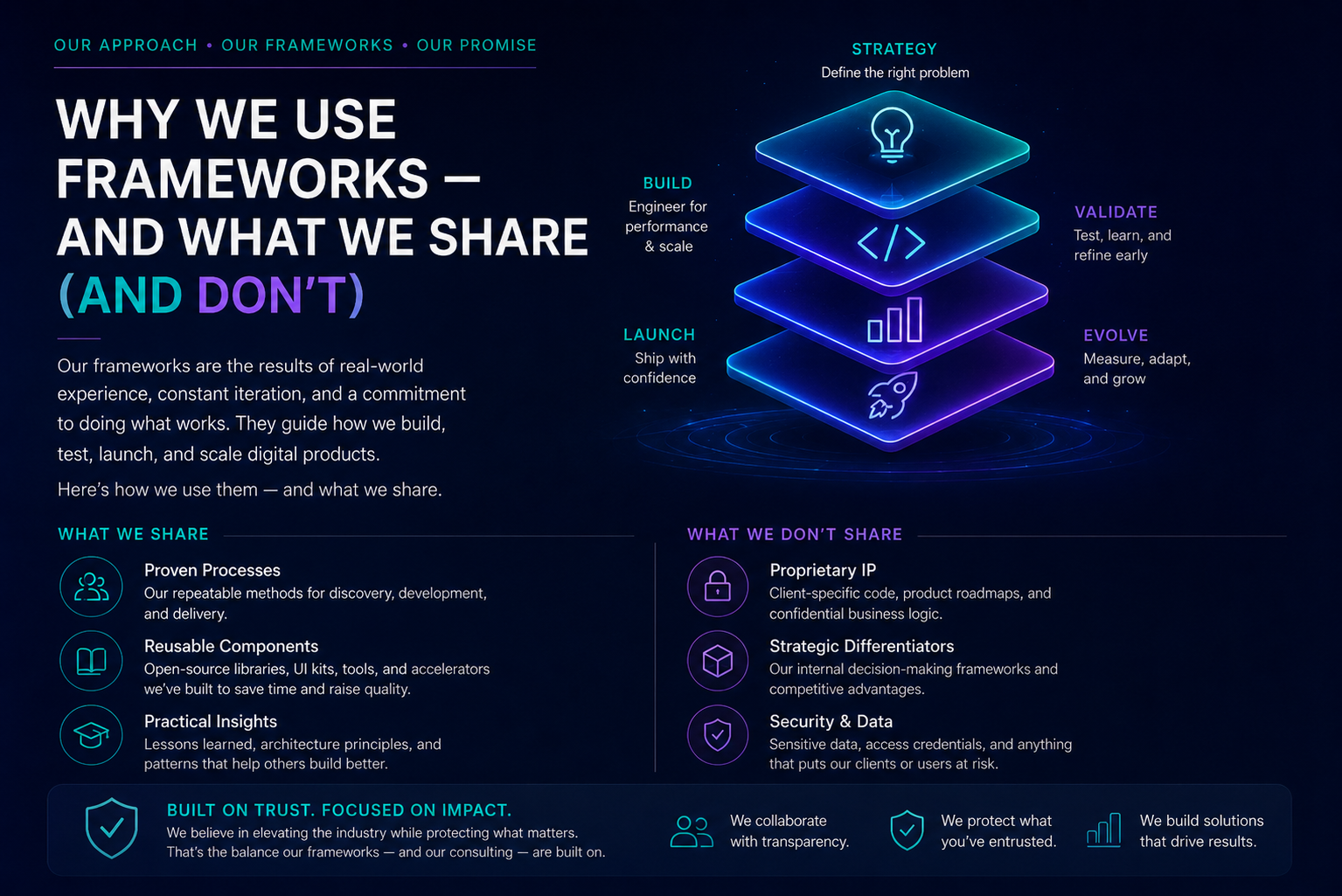
Most teams do not fail because they lack tools. They fail because every project reinvents the same decisions—how fast is fast enough for a prototype, where secrets live, whether AI output is allowed to block the UI, whether mobile means a WebView or a native client. Frameworks are how we stop paying that tax twice.
At A.M. Tech Consulting, frameworks are not slide decks from a certification program. They are written habits distilled from real delivery work across web products, APIs, data and AI systems, mobile clients, and cloud infrastructure. They exist so we can move quickly without treating "MVP" as permission to skip security, accountability, or reproducibility. This post explains our stance—what frameworks are for, how we use them on engagements, and what we intentionally keep out of public view so clients still get the depth they are paying for.
WHAT WE MEAN BY "FRAMEWORK"
A framework, for us, is a decision scaffold: principles, gates, and vocabulary that help a team choose correctly under time pressure. It answers questions like:
- What must be true before we call this prototype demo-ready?
- What risk class is this AI feature, and what controls follow?
- Does this product need a native app, a wrapper, or something in between?
- What does a repository need on day one so the next developer is not archaeology?
A framework is not a 400-page methodology binder. It is not a substitute for reading your codebase. It is not intellectual property we dump wholesale on the internet—because the value in consulting is applying judgment in context, not handing someone a checklist and wishing them luck.
We organize our internal standards into a small library of composable documents: rapid delivery lifecycle, repository hygiene, responsible AI governance, mobile delivery options (wrapper vs native), full-stack launch sequencing, event and demo reliability, and content operations for how we publish what we learn. You do not need every document for every engagement. You need the right two or three, applied with evidence from the system in front of you.
OUR STANCE IN FIVE PRINCIPLES
1. Evidence over ideology
Frameworks are updated when builds teach us something—not when a vendor releases a white paper. If a pattern repeats across repositories and incidents, it earns a place in a framework. If it happened once, it stays a lesson learned note, not a rule.
2. Thin slices before broad roadmaps
We favor one end-to-end happy path through UI, API, and data before expanding feature surface. Frameworks encode that sequencing so stakeholders see working software early and scope debates stay honest.
3. Security and governance are prototype requirements
Secrets vaults, identity patterns, input validation, and AI fallback behavior are not "phase two" for us. The depth scales with risk—a low-risk summarization feature and a high-risk decision support feature do not get the same controls—but the question is asked on day one, not after a demo embarrassment.
4. Frameworks compose; they do not collide
Mobile delivery guidance does not override AI governance. Repository standards do not pretend every repo is a product repo. We pick the layers that match the engagement: a WebView preservation project gets a different entry point than a greenfield SwiftUI app with offline sync.
5. Public philosophy, private application
What we publish explains why we work this way. What we bring to a client engagement includes tailored runbooks, verify scripts, architecture notes, and trade-off memos tied to their stack and constraints. That applied layer is consulting work—not a free download.
WHAT THE LIBRARY COVERS (AT A HIGH LEVEL)
Without turning this post into an internal table of contents, our frameworks cluster into four areas readers can expect us to speak fluently about:
Delivery speed with discipline
How we frame problems, bootstrap repositories, ship a vertical slice, stabilize quality, and validate before external demos. The recurring theme: reproducible environments, seeded data, staged gates (local, CI, deploy), and explicit non-goals.
Engineering hygiene
How we expect product and service repositories to explain themselves—setup, tests, deployment, secrets strategy—and how CI/CD should treat identity and migrations. The recurring theme: README-first engineering and failing fast before production learns the lesson.
AI that survives contact with users
How we classify AI features by risk, separate deterministic truth from generated language, require fallbacks, and monitor without logging sensitive content. The recurring theme: the product must work when the model does not.
Platform-specific delivery
How we choose among web preservation, hybrid mobile, and native clients; how we sequence iOS plus backend plus cloud when timeboxed; how we keep demos reliable under weak networks. The recurring theme: least native surface that meets the bar—evidence, not fashion.
These are conversation starters with a technical buyer. They are not the engagement.
WHAT WE DELIBERATELY DO NOT GIVE AWAY
We believe transparency builds trust. We also believe clients hire us for applied expertise. The following stay internal or inside paid work:
- Step-by-step playbooks with hour-by-hour sequencing tuned to a specific cloud and stack
- Operator scripts, verify commands, and infrastructure templates wired to real environments
- Prompt contracts, guardrail implementations, and model routing details for AI products
- Identity tenant configurations, OAuth parameter matrices, and session-sync designs for production apps
- Client-specific architecture diagrams, post-mortems, or repository names used as evidence
Public posts—like our writing on stepping into iOS—share patterns and lessons without exposing credentials, tenant identifiers, proprietary product mechanics, or copy-paste runbooks that replace a discovery call. If you read our blog and feel you received a complete implementation kit, we overshared. If you understand how we think and want that thinking applied to your system, we pitched it correctly.
HOW FRAMEWORKS SHOW UP ON AN ENGAGEMENT
A typical and high-level arc for us:
Discovery
We map your goal, constraints, and risk profile to the smallest set of frameworks that matter. Wrapper vs native is answered here if mobile is in scope. AI risk class is answered here if models are in scope.
Alignment
We write a short decision memo in plain language: what we will optimize for, what we will not do in v1, and which gates define "done" for the next milestone. This is where frameworks become yours, not ours—your non-goals, your compliance context, your team shape.
Execution
Developers work from repos, not from mystery process. Frameworks inform pre-push habits, CI expectations, and review questions. We do not pause delivery to ceremony-read a binder.
Handoff
You keep the artifacts that matter: architecture notes, runbooks, action items, and the rationale behind trade-offs. The internal framework library remains our accelerant for the next engagement; your codebase remains the source of truth.
Clients do not buy a PDF collection. They buy fewer wrong turns.
WHO THIS IS FOR
Frameworks-heavy consulting is a fit when:
- You are shipping under real deadlines but cannot afford a security or credibility incident
- You are adding AI to a product and need governance without paralysis
- You are moving from web to mobile (or vice versa) and want an explicit delivery decision
- Your repositories work for one hero developer but fail onboarding and operations
- You want a partner who will say "not yet" to scope as readily as "yes"
It is a poor fit when you only want staff augmentation with no interest in how work is gated, or when you want a fixed methodology applied regardless of evidence.
Frameworks are how A.M. Tech Consulting makes fast delivery legible and safe. They encode recurring lessons from polyglot, cloud-connected, AI-aware product work—without pretending every project is the same. We share the philosophy publicly so you know how we think. We apply the depth on engagements so you get outcomes, not homework.
If that balance matches what you are looking for, we would welcome a conversation about your next prototype, platform decision, or hardening pass—starting with your constraints, not our buzzwords.
Final Thoughts — REACH OUT!
Planning a prototype, an AI feature, a mobile path, or a repository standards pass? We help teams frame the decision, apply the right gates, and ship with less rework. Visit amtechconsulting.org or use the contact page on our site to reach out. Tell us what you are building and what "done" means for the next milestone—we will respond with whether we are a fit and what a sensible first step looks like.